



Peter Reichel, Chief Investment Officer ODDO BHF SE
U.S. quarterly results show robust growth
- Strong earnings growth in the United States in the second quarter
- Earnings momentum is broadening
- Greater awareness of risks is required
Artificial intelligence is the dominant investment theme in the U.S. equity markets and, in our view, rightly receives extensive attention. However, corporate reports for the second quarter of 2026 clearly show that the positive results extend far beyond artificial intelligence (AI) and the technology sector. According to research firm FactSet, earnings of companies in the S&P 500 increased by around 50 percent year-on-year in the second quarter. This represents the strongest growth since 2021, when the prior-year quarter was heavily affected by the outbreak of COVID-19. In 86 percent of cases, reported earnings exceeded analysts’ estimates. While systematic underestimation is not unusual, it is rarely seen on this scale. The “surprise factor” is also at its highest level since 2021.
However, these extraordinary percentage figures should be interpreted with caution. Two special factors significantly distorted the results. Google parent company Alphabet reported an unrealized pre-tax valuation gain of approximately USD 98 billion on equity securities and shareholdings. This paper gain resulted primarily from the revaluation of investments in companies such as SpaceX and Anthropic and pushed quarterly earnings per share to a historic USD 9.11. Excluding this one-off effect and several smaller items, adjusted earnings per share would have been between USD 2.48 and USD 2.90, reflecting the company’s normal operating business.
A similar effect was observed at Amazon. In the second quarter of 2026, the e-commerce group also recorded a substantial one-time gain from the revaluation of its stake in AI developer Anthropic, which is targeting an IPO in October. Amazon reported a non-operating pre-tax gain of USD 53.4 billion, lifting net income to a record USD 62.6 billion. As with Alphabet, Amazon’s reported earnings per share would have been significantly lower without this valuation effect.
According to FactSet, if these special effects are excluded, S&P 500 earnings growth for the second quarter would have been around 32 percent. In our view, this still represents an exceptionally strong result, especially against the backdrop of numerous geopolitical conflicts around the world.
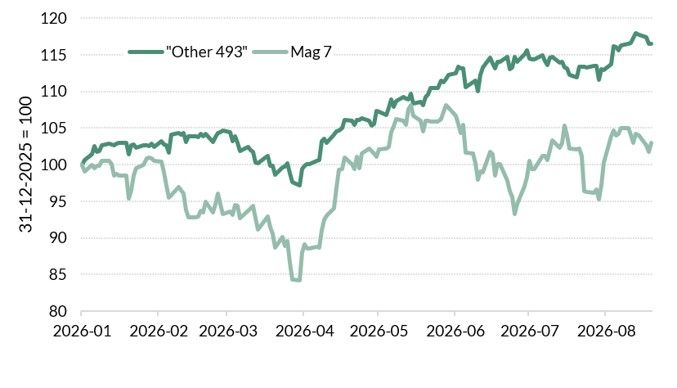
In our analysis of the quarterly figures, however, the key focus was not the magnitude of earnings growth but rather whether earnings momentum is becoming broader. We still clearly remember the discussion surrounding the “Magnificent Seven” (Mag Seven). For a period, the seven technology stocks Alphabet, Amazon, Apple, Meta, Microsoft, Nvidia, and Tesla drove the S&P 500 upward almost single-handedly, while the other 493 constituents lagged behind. In the second quarter, partly due to the special effects mentioned above, the Magnificent Seven achieved extraordinary earnings growth of approximately 120 percent, according to Bloomberg. Yet the remaining S&P 500 companies also posted impressive earnings growth of roughly 30 percent. This trend is reflected in stock market performance. We view this development as evidence of the strength of the U.S. equity market. The leadership role of the Magnificent Seven is gradually diminishing, without reducing their fundamental importance to the market.
Chart 1: U.S. equity market performance during 2026: Magnificent 7 and the “Other 493”

Source: Bloomberg, Total Return
Of the five companies making the largest contributions to earnings during the April to June period, only one belongs to the Magnificent Seven: semiconductor manufacturer Nvidia, which holds a dominant market position in high-performance chips for AI applications. The other four companies are also well-known names: Micron manufactures memory components for computers, Chevron and Exxon Mobil are two of the world’s leading oil companies, and Broadcom produces integrated circuits for networking applications.
The current strength of the U.S. equity market is also evident in the fact that earnings momentum has broadened significantly: ten of the eleven sectors recorded positive year-on-year earnings growth. The only exception was the healthcare sector. The sector was primarily affected by changes in U.S. healthcare and pharmaceutical policy, increased regulatory pressure, and uncertainties related to tariff and trade policies.
Beyond such special influences, there are several reasons to believe that the U.S. equity market may continue to broaden in the coming months. According to analysts’ estimates, earnings of the remaining 493 S&P 500 companies could grow by around 25 percent, thereby increasing for the first time faster than earnings of the Magnificent Seven, which are expected to grow by just under 23 percent. Additional support for broader growth comes from rising investments in infrastructure, digitalization, and artificial intelligence, which are stimulating other areas of the economy.
Given these developments, we remain fundamentally positive about the U.S. equity market. However, we see no reason for excessive optimism. Uncertainty regarding geopolitical and economic policy developments remains very high. This creates specific risks that are difficult to capture in forecasting models. The escalation in the Middle East is one example of how quickly political developments can alter market assumptions.
Furthermore, developments in the bond market should be monitored closely. Rising long-term yields increase financing costs and simultaneously raise the hurdle rate for other, riskier asset classes such as equities.
Nevertheless, we currently consider the U.S. equity market to be resilient. Whether it remains so will depend in part on whether earnings momentum continues to broaden. The more earnings growth expands from a small number of mega-cap companies into additional sectors, the stronger the foundation for the stock market will be in the second half of 2026 and beyond. In our opinion, a broader earnings base should further enhance the attractiveness of the U.S. equity market.
Even so, investments should be made with heightened risk awareness. Based solely on the price-to-earnings ratio, U.S. equity market valuations appear moderate to high at first glance. However, this assessment becomes more nuanced when the strong expected earnings growth underlying current valuations is taken into account. The decisive factor for market performance going forward will therefore be whether companies can actually deliver the earnings growth that is already priced into the market.
Investors are reminded that past performance is not a reliable indication of future returns and is not constant over time. Past performance, simulations or forecasts are not a reliable indicator of future results.Returns may rise or fall as a result of currency fluctuations. Any opinions expressed reflect the current assessment of the Investment Office of ODDO BHF SE, which may differ in particular from the house view within the ODDO BHF Group and may change without prior notice.
IMPORTANT INFORMATION
The information and presentations contained in this document are provided for informational purposes only and constitute neither investment advice nor an investment recommendation within the meaning of the German Securities Trading Act. The analyses should not be understood as a recommendation to buy or sell. Past performance is not a reliable indicator of future performance. Markets are subject to fluctuations; the value of an investment may rise as well as fall. Statements regarding future market developments are based on assumptions and estimates that may prove to be inaccurate. To the extent that specific individual securities, sectors or markets are discussed in this report, this represents the current opinion of the Investment Office of OBSE at the time of preparation, which may change at any time as a result of changes in market, competitive or general conditions. The bank gives no guarantee that the securities or market segments mentioned will achieve the expected performance.
© 2026, Publisher: ODDO BHF SE, Gallusanlage 8, 60329 Frankfurt am Main. All rights reserved.